Every day, millions of digital marketers log in to the same keyword tools, search for the same keywords, and generate the same reports. When a search term has a relatively high comfortable monthly volume in a normal database, it's too late. That very piece of data has been seen by dozens of your competitors. They've already created the blogs, created the landing pages, and secured the #1 position on Google. There is no competition, only playing catch-up.
Brands in the visibility game have left the past behind and are now in the future (2026). Instead, they utilize the strength of AI to forecast consumer concerns and the change in consumer dialogues even before they are detected by the mainstream press.
We develop modern digital architectures at Wish Geeks Techserve in SaaS, mobile apps, custom enterprise systems, and retail e-commerce. We understand that creating a fabulous platform is just half the job; you'll also need to get your audience to discover you before the competition builds up. This guide breaks down exactly how to stop chasing historical data and start riding search waves before they even form.
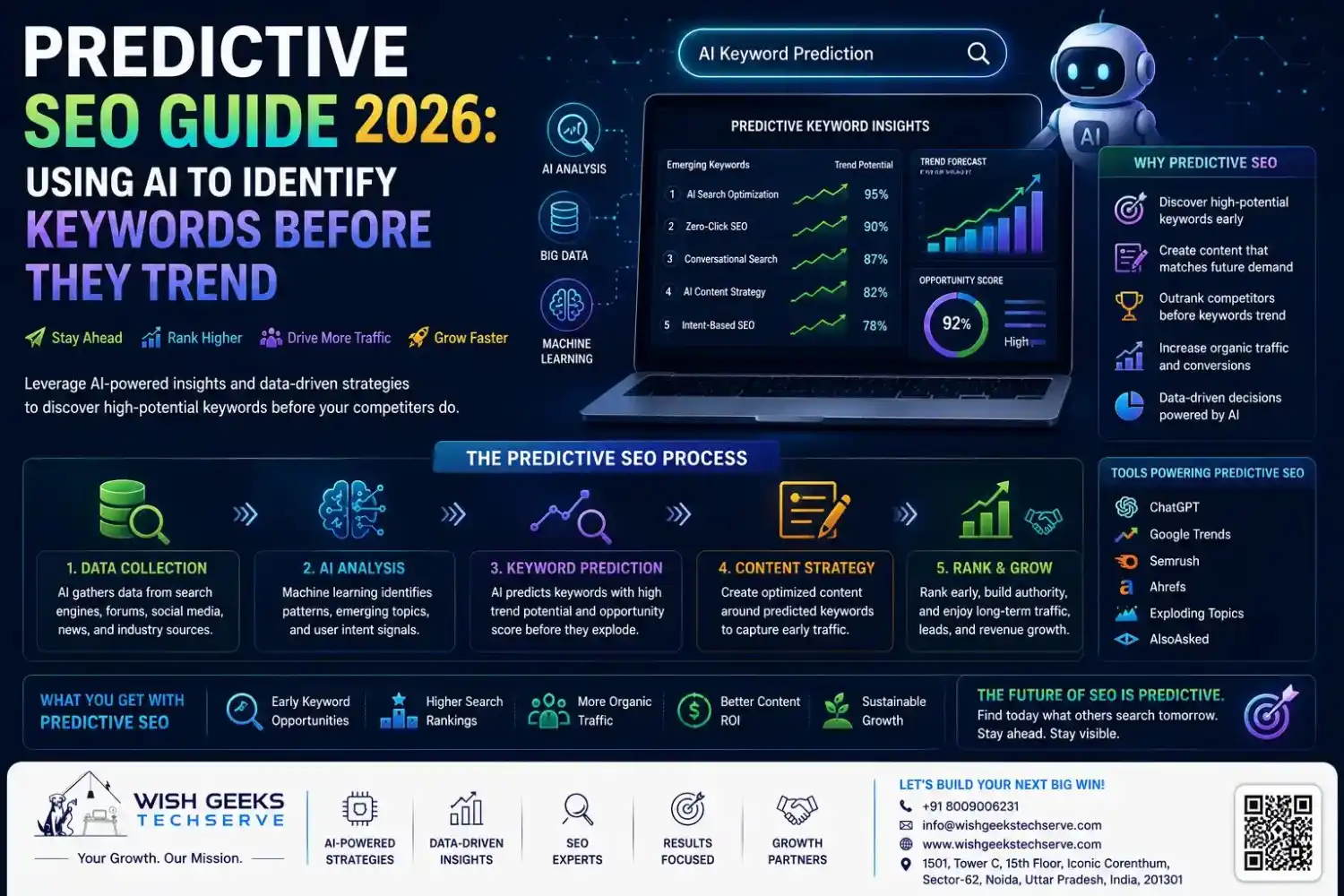
Predictive SEO involves leveraging machine learning and live language tracking to anticipate users' future search queries.
Traditional SEO is like looking at a rearview mirror; if it works for you, you know what you've done in the past, but you're not sure how to make the next move. Predictive SEO is similar to a radar. It tracks live language shifts, developer updates, and forum discussions to show you where the traffic waves are actually forming.
Feature / Dimension | Traditional SEO (Reactive) | Predictive SEO (Proactive) |
Primary Data Source | 30–90 day old aggregated search logs | Real-time AI linguistic tracking & signals |
Content Lifecycle | Published after a traffic spike registers | Fully indexed before the trend peaks |
Competition Level | Exceptionally high (Fighting for crowded terms) | Near zero (Unoccupied digital real estate) |
Google Algorithm Fit | Flagged as a repetitive rehash of existing sites | Rewarded as a primary source (High E-E-A-T) |
Google's AI Overviews and conversational search models are looking for a page that offers new, unique answers in 2026. They want to bring to light the pioneer, the site that has found the solution before the other sites on the web did.
The fundamental flaw of traditional keyword tools is data latency. Software suites do not scrape the entire internet in real-time; they collect search logs over weeks, clean the data, and present an average. This creates major operational blind spots:
AI algorithms don't guess future trends. They operate on a simple principle: Before a trend becomes a keyword, it starts as a disorganized human conversation. Long before someone types a clean query into Google, they are talking about their unfiltered problems in raw text environments across the web.
Message boards on platforms such as Reddit, Discord, and industry platforms are pure gold. When users encounter a frustrating bug, a change in supply chains, or another obstacle posed by a company, they turn to crowdsourced assistance. AI scans these forums for frustration sentiment. A sudden spike in searches for terms like "workaround" or "how do I bypass" related to a service is a clear indicator that a search trend is about to explode.
If you're a company in the SaaS or mobile application business, the developer activity on sites such as GitHub is akin to a crystal ball. If developers start to post issues or commit code patches around a brand new framework, API change, or OS beta, then it gives them a few months to get a head start on the consumer issues that will inevitably follow when it is released to the general public.
Changes in the law, compliance, or company policies are often the initial drivers of major industry changes. You can train AI to watch for new draft laws, patent applications, and data tracking policies in other countries, and you can get technical terms, acronyms, and operational requirements that the general public has never heard of.
Moving away from old, reactive keyword methods doesn’t require completely rewriting your marketing playbook. It’s simply about plugging a smart data pipeline into your existing content production workflow.
1. Raw Signal Capture: Phase 1.
Deploy specialized AI agents to continuously monitor open forums, developer logs, and global tech updates to flag sudden spikes in specific combinations of nouns and verbs.
2. Semantic Definition: Phase 2.
The AI takes chaotic conversational data and translates it into clean, high-intent search phrases (e.g., converting fifty forum complaints into a targeted long-tail keyword string).
3. Trajectory Verification: Phase 3.
The system filters out temporary background noise by evaluating the acceleration of the discussion against historical data arcs to ensure it's a sustainable trend.
4. Preemptive Content Architecture: Phase 4.
Your team publishes structured topic clusters around these validated phrases, ensuring Google's web crawlers index and trust your site as the primary authority before the traffic spike arrives.
In today's search landscape, it's much more important to be first than it is to be ideally optimized. If you have the topic at a lower volume, then you have the rankings for the long-term.
While predictive targeting applies to all digital industry segments, it gives an unfair competitive edge to the companies in the fast-changing industry segments.
There is a huge trap that many brands fall into when they start using AI for SEO: they assume that because the machine found the data, the machine should also write the content.
Google’s search evaluation systems look specifically for E-E-A-T: Experience, Expertise, Authoritativeness, and Trustworthiness. AI is a brilliant research assistant, but it makes for a terribly dry writer. It cannot share a personal story about a late-night server migration gone wrong. It cannot explain the relief of fixing a broken app architecture five minutes before a major product launch.
The best way to get on top of search results is to leverage artificial intelligence to find content ideas, and then hire real human experts to write that content. Predictive topic discovery and deep content with authentic, human stories equals content that will keep users on the page for longer, and make your site a highly trusted source of genuine content for Google.
At Wish Geeks Techserve, we combine cutting-edge data engineering with clear and concise storytelling, ensuring your brand resonates with the human audience, addresses their pain points and outranks your competitors in search results, while maintaining clean and sustainable results.
Also Read: From SEO to GEO: How to Optimize Content for AI Search Engines
The biggest advantage is ranking with near-zero competition. By publishing content before a keyword becomes widely known, you lock down page-one visibility and build early authority.
Because standard tools rely on historical averages. A brand-new problem or emerging tech trend hasn't accumulated months of data yet, causing old tools to incorrectly label it as a zero-volume phrase.
Google values original, expert-driven content. When you publish solutions to emerging problems before anyone else, Google sees you as a primary industry source. When other sites eventually catch on, they naturally link back to your articles, boosting your trust and authority scores.
The analysis of the data and the identification of trends can be done with the help of AI, but it is the personal touch, hands-on engineering skills, and strong storytelling that will help users feel a connection to the brand and build trust in the brand over time.
Success is measured by monitoring impression growth and early rankings. As the public awareness of the trend grows, you will see a direct, uncontested surge in organic traffic and conversions.
Thank You for showing interest in our services. Here’s how you can reach us...

info@wishgeekstechserve.com

OUR ADDRESS
Sector-62, Noida, Uttar Pradesh




.7f54be30.webp&w=256&q=75)