Imagine you're standing at a crossroads. You've come up with a great idea for a mobile app that can really help your business to grow. You have a great plan, a great team, and your aims are well-defined.
But just a few steps ahead of you, the road forks, and one way leads to Android (Apple's rival operating system) and the other to iOS (Apple's operating system). Your decision on which platform to develop on will not only determine your initial investment and the way you will generate revenue, but also your target audience size and ultimately your profit over a long time (ROI). Choosing to create an Android app means making it accessible to a large global user base; Though, an iOS app targets a more affluent segment of users who are big spenders and very loyal to the brand.
Let's remove the excessive technical jargon and look at this decision from a business growth point of view.
Also Read:WordPress vs Custom Website Development: Which One is Better for Your Business?
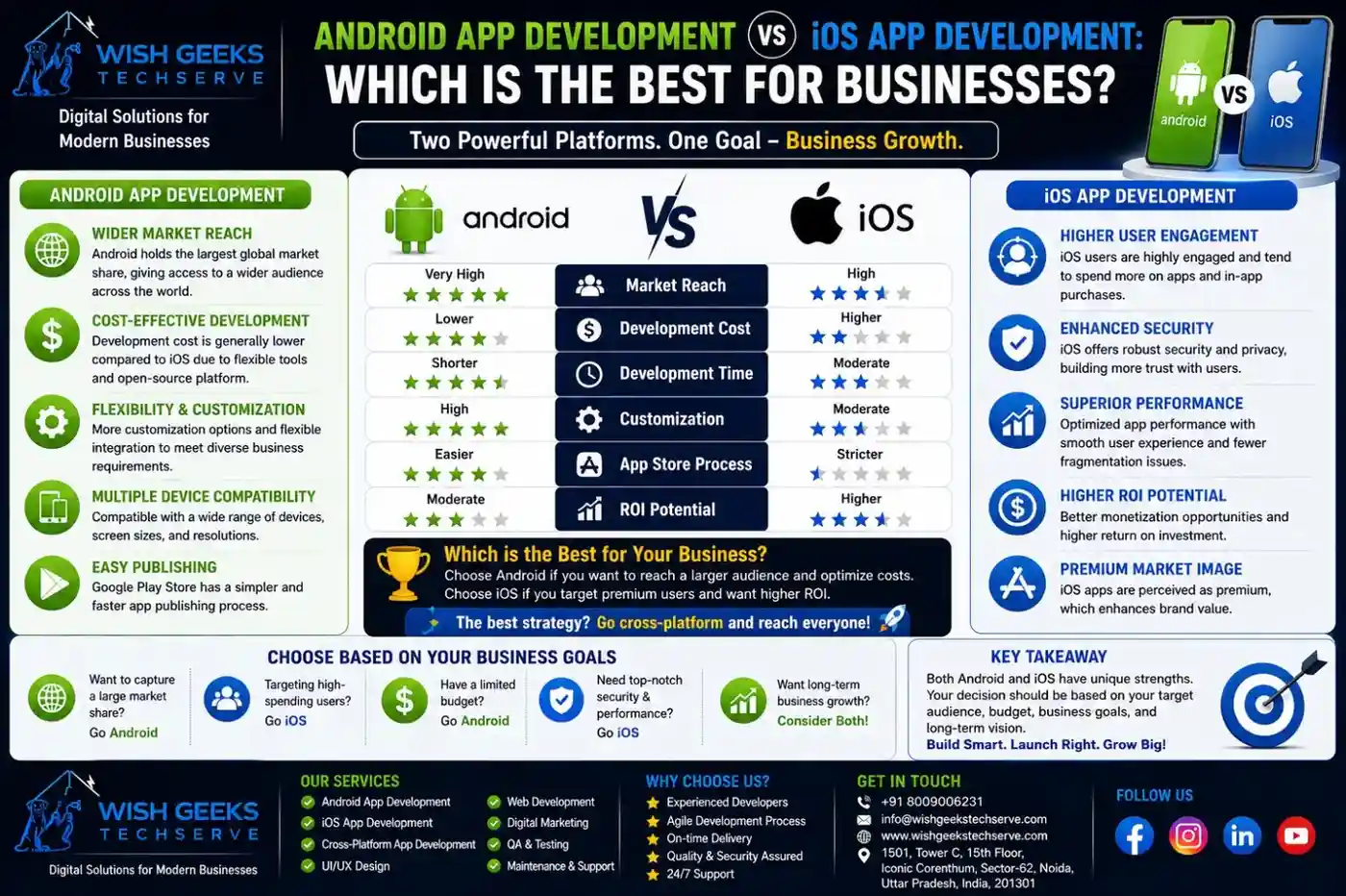
You need to know who these two digital platforms are home to to make the best decision for your unique business. Android vs. iOS can be boiled down to one simple word: Android wins when it comes to scale, and iOS wins when it comes to spending money.
Android is a free-to-use operating system software that is found on many devices worldwide, starting from very cheap mobile phones all the way to the most expensive top-of-the-range ones. This is the flexibility that allows Android to be the leader globally, accounting for about 70% to 75% of the market. Often, Android's share in the market is more than 85% in rapidly growing territories in Asia, Africa, Latin America, and Europe.
Android provides an unrivaled global platform for your company if you're looking to reach mass adoption, create a brand awareness campaign, or develop a service that's used by a very diverse group of people (such as a service for a field team logistics tracker or an enterprise resource planning application).
Apple takes the exact opposite approach. With a closed and controlled environment, Apple is solely interested in a high-end and premium user base. iOS currently makes up about 25% to 30% of the global market share, but it entirely dominates the high-income markets such as North America, the United Kingdom, and Australia, sometimes accounting for more than 55% of the market share.
The most important trait of iOS users is their financial habits. Even though Apple users make up a smaller share of global app downloads, they are generally more willing to spend on premium apps, digital services, and in-app purchases compared to Android users.
Let's take a look at these demographics side-by-side, on a structural level:
Business Metric | Android App Development | iOS App Development |
Global Market Share | Dominant (~70% - 75%) | Selective (~25% - 30%) |
Target Demographics | Broad, diverse, value-conscious | Affluent, tech-focused, brand-loyal |
Primary Geographic Hubs | Asia, South America, Africa, Eastern Europe | North America, Western Europe, Australia |
User Monetization Style | High volume, ad-supported, freemium | Premium downloads, direct subscriptions |
The technology stack that is used to build software from your vision is quite different when you hire mobile developers to do it for you, depending on the platform you choose. This is a factor in the time it will take to develop your product and how well it will run.
The common languages when developing an Android app are Kotlin and Java, which are supported by Google's official Android Studio.
The open-source nature of Android offers your development teams a good deal of structural freedom. Android is open, so if your business application needs to be deeply customized, to have unique integrations with custom physical hardware, or to communicate with the back-end system, these are much easier to do.
However, this flexibility comes with a considerable downside referred to as device fragmentation. Your app should not only be aesthetically pleasing on one device, but it should also be beautiful on thousands of different device models from different manufacturers with different screen sizes, processor speeds, and customized OS skins.
The other side of the fence, native iOS app development is mostly based on Apple's modern and clean programming language, Swift, which is developed in their special tool, Xcode.
It's easier to predict what will happen when you develop for iOS. Since Apple owns both the hardware and software, your development team only has to tweak the application for a very limited and consistent iPhone and iPad family. This uniformity makes designing user interfaces, making layout changes, and running performance diagnostics very easy.
One of the most prevalent misunderstandings in the business world is that you will have to cut your development budget in half if you select one platform over the other. The truth is much more complicated.
If you're just focusing on creating and testing your first working prototype (MVP), you can create an iOS app faster. Your Quality Assurance (QA) team has to spend a lot less time finding display bugs or performance lag, as there are fewer variations in devices to be considered.
Android apps often need lengthy testing periods. Optimization takes additional hours of your developer's time, and sometimes can add 10% to 20% to the initial development timeline, to ensure a smooth user experience on a premium flagship device as well as on an entry-level smartphone.
Although iOS may have the advantage of getting to market first, the cost of maintenance over time is another matter:
In today's digital era, where businesses often deal with sensitive user information, including financial transactions, healthcare records, or even confidential corporate logistics, security is no longer a luxury but a must-have.
Once you've made your app, it is necessary to submit it for review before it can be accessible to the general public.
Google Play has made an efficient, highly automated, and flexible reviewing system. This enables businesses to roll out updates, deploy quick bug fixes, and make iterations to their product without too much delay.
The App Store has a strict, manual review system that is based on its strict guidelines on Human Interface (HIG). Apple reviews all submissions for consistency, privacy compliance, and absolute performance stability. This is a very strict process that can sometimes cause a few days' delay in the launch, or cause the initial rejection for minor layout inconsistencies, but it is a very strong badge of credibility. When your business app passes Apple's review, it's a clear sign to users that it's extremely secure and well-designed.
To find out which mobile ecosystem is the ideal fit for your business goals, go through this practical business decision guide:
Get Started: What is your main mobile business objective?
Option A: Global Reach & Deep Customization – maximize.
Choose Android First
Option B: To maximize Direct Revenue & Premium Branding.
Choose iOS First
If your potential audience splits evenly and you really have to be in both stores to be competitive, what are you going to do? Producing two separate native apps can be quite a load on the internal team and perhaps double the cost for many small-to-medium businesses and startups in the growth phase.
This is exactly when cross-platform development saves the day. Through the use of state-of-the-art engineering solutions like Flutter or React Native, dev teams will only need to write one codebase, which will be magically transformed into gorgeous Android and iOS apps.
This clever solution means you'll save on your initial development costs, have a consistent brand layout on every device, and save half of your maintenance hours in the future since any future changes will only need to be coded once.
In the end, there are no right or wrong answers when it comes to Android vs. iOS. It all depends on your business objectives, audience, and future growth plans.
This decision can be a daunting one to make on your own, but you're not in it alone. We at Wish Geeks Techserve specialize in making your ideas into a successful digital reality. We don't think that any templates fit everyone. We are a group of professional marketers and developers who will not rush into the process. First, we will analyze your business environment and target audience, then come up with a mobile strategy that not only fits your needs but also your personality.
You name it, from a tailored Android app that can work with an enormous global user base, to a very attractive native iOS app that will lure high-end users, to an extremely performant cross-platform offering that, by curling can reach both markets at once, our technical knowledge and industry wisdom are at your disposal to develop a scalable, future-proof piece of software.
It is time to turn your idea into a valuable business resource. Contact the Wish Geeks Techserve team now, and together we will set sail towards mobile success!
Is it possible to launch the app on both Android and iOS together?
Really, it is feasible for you to release on two platforms simultaneously. Actually, that is a very common approach of many companies that want to expand their user pool immediately. To enhance the speed and reduce the expenses, with a view to the outer work developers, but quite often resort to the use of Flutter and React Native as well, for a single app, which runs Android and iOS flawlessly, can be created very easily this way.
Why is it that iOS apps usually gain more revenue?
iPhone owners, as a rule, are more willing to pay for subscriptions, buy premium features, and get digital services. It is one of the main reasons why iOS apps typically produce higher revenue. But Android apps are very effective in reaching many users, mostly in countries where most people use Android phones.
Which app takes more maintenance, Android or iOS?
Android apps generally have to undergo more testing and maintenance as there are the largest variety of devices, screen sizes, and brands among the Android market players. As far as iOS is concerned, the ecosystem is quite controlled since Apple is the one in charge of both the software and hardware. Yet, iOS apps are to be refreshed on a regular basis to stay up to date with Apple's new requirements and system updates.
How long does it usually take to get app approval on the Google Play Store and Apple App Store?
Typically, Google Play Store app approvals are quicker, and you may even get your app approved within a few hours. Though sometimes it could take a day or two. Since Apple has a tougher review system, the time for app approvals on the App Store is longer, typically one to three days.
Which platform is more suitable for a startup in developing countries?
For example, if you are targeting India or other developing countries, then Android would be the best option to start with. As people using Android phones are in the majority, it allows businesses to get a bigger reach from the beginning.
Thank You for showing interest in our services. Here’s how you can reach us...

info@wishgeekstechserve.com

OUR ADDRESS
Sector-62, Noida, Uttar Pradesh




.7f54be30.webp&w=256&q=75)